
Dual Ion Beam Deposition of Nano Anti-Wear Coatings for Precision Micro Cutting Tools
The miniaturization of components is an unbroken trend in many industrial sectors, such as medical technology, automotive engineering, aerospace, tool and mold manufacturing as well as microelectronics. A major cost factor in the production of these components is the limited lifespan of the tools due to high wear. Standard coating processes such as CVD (chemical vapor deposition) and PVD (physical vapor deposition) can extend the service life. However, these coating processes produce layer thicknesses in the µm range, which result in rounded cutting edges that lead to significant quality deficiencies for sub-mm drill diameters.
New coating solutions are required to produce layers that meet the following requirements:
- Very small coating thickness to avoid rounding of the cutting edges
- Uniform layer thickness, especially along the cutting edges
- High coating thickness uniformity over a large number of tools
- Hard coatings for low wear
- Good adhesion to the tools, because premature chipping of the coatings would significantly shorten the lifetime of the tools compared to uniform abrasion caused by wear
- Heat resistance, as high cutting speeds lead to significant heating of the tool material
- Cost-effective, so that the coatings are as economical as possible
As part of the “NanoTools” joint project, it has been demonstrated that both atomic layer deposition (ALD) and dual ion beam deposition (DIBD) are capable of producing thin coatings that lead to an increase in service life of up to 6 times by investigating Al2O3 coatings on commercial drills with diameters of 3 mm and 0.3 mm. (see also news of 2017-06-02)
Based on these results, the aim of the follow-up project ENAL (Einsatz Nanobeschichteter Werkzeuge in der Leiterplattenfertigung - Use of Nanocoated Tools in PCB Manufacturing) was to carry out extensive, near-production tests on micro tools to develop a new generation of coated micro cutting tools with nano wear protection coatings, thus reducing the manufacturing costs of various cutting tools used for fine or micro machining.
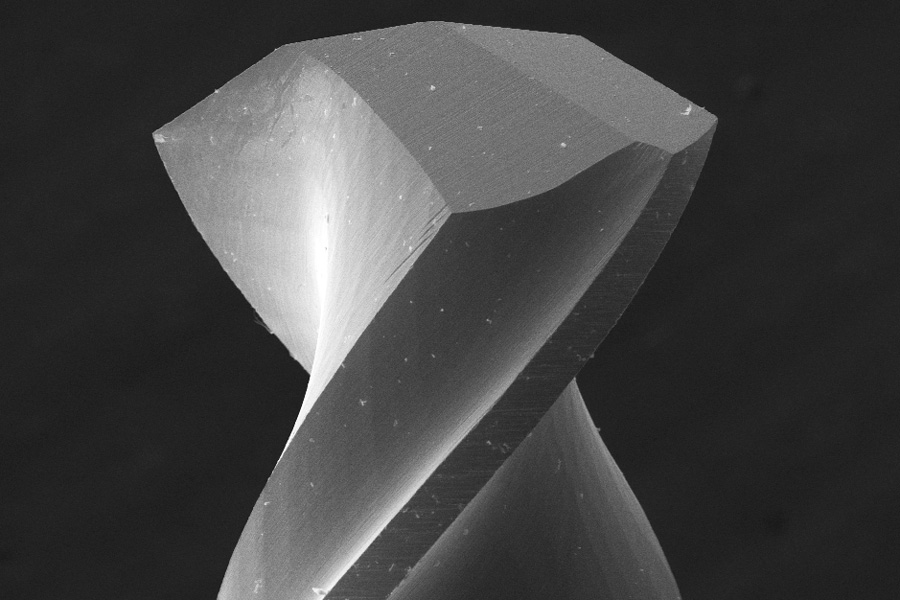
Fig. 1: SEM image of a drill tip after ultrasonic bath, oxygen plasma and etching

Fig. 2: Structure of the coatings
Related Information
Related Products: scia Coat 200
- In-situ change of coating materials due to rotational target holder with up to 5 water-cooled targets
- Controlled multilayer deposition based on process recipe
- Process monitoring with quartz crystal oscillator and/or optical thickness monitor (OTM) and test glass changer
- Direct wafer handling or adaptation to variable substrate sizes with carrier handling

Reach out
Please contact us for further information.
Any questions left?
scia Systems GmbH
Clemens-Winkler-Str. 6c
09116 Chemnitz
Germany